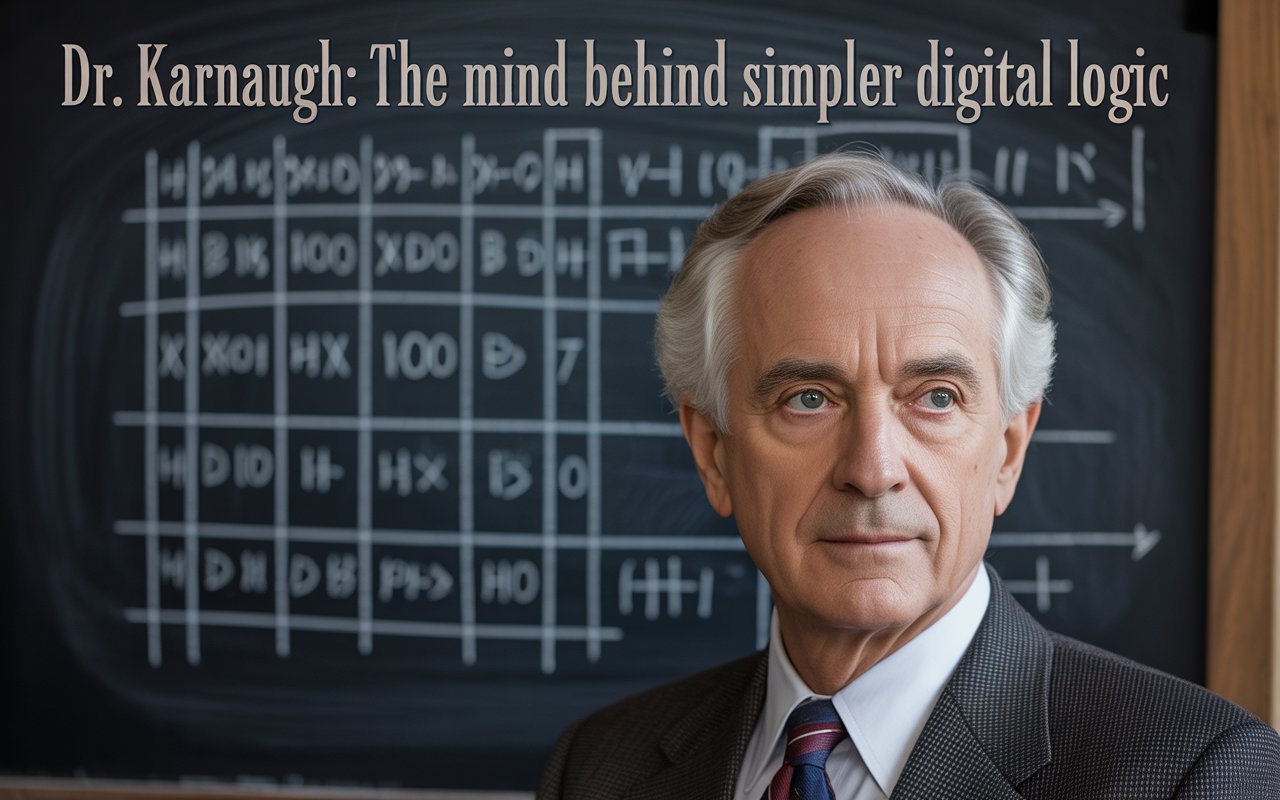
Dr. Karnaugh: The Mind Behind Simpler Digital Logic

When you tap your phone, stream a video, or even use a calculator, there’s a hidden layer of logic quietly making everything work. Behind that simplicity lies a powerful idea that transformed how engineers design digital systems. At the heart of it is a man whose contribution is often overlooked but deeply influential:Dr. Karnaugh Maurice Karnaugh.
So, who was he?So why does his contribution continue to shape the technology we rely on today?
Let’s break it down in a way that actually makes sense—no complicated jargon, just clear ideas you can follow.
Who Was Dr. Karnaugh?
A Quiet Innovator in a Growing Tech World
Maurice Karnaugh was an American physicist and mathematician who worked during a time when computers were still in their early stages. Born in 1924, he contributed to the field of digital electronics at a time when engineers were trying to figure out how to make circuits faster, smaller, and more efficient.
He worked at Bell Labs, a place known for groundbreaking innovations like the transistor and early computing systems.
Why He Matters
While many people were working on complex theories, Karnaugh focused on making things simpler. And that’s exactly what made him stand out
The Problem Engineers Faced
Too Many Complex Expressions
In early digital design, engineers used Boolean algebra to create logic circuits. While powerful, it often led to long and messy expressions. Imagine trying to solve a puzzle where every step adds more confusion instead of clarity.
The Need for Simplification
The more complex the logic, the more hardware was required. That meant:
- More wires
- More power consumption
- Higher costs
- Increased chances of errors
Clearly, something had to change.
The Birth of the Karnaugh Map

A Simple Yet Brilliant Idea
To solve this problem, Karnaugh introduced a visual method called the Karnaugh Map, often shortened to K-Map.
Instead of dealing with long equations, you could now see the logic laid out in a grid.
Think of it like organizing a messy room. Once everything is arranged neatly, it becomes easier to spot what you don’t need.
What Is a Karnaugh Map?
A Visual Tool for Logic Simplification
A Karnaugh Map is a diagram used to simplify Boolean expressions without complex calculations. It arranges values in a way that helps you quickly identify patterns.
How It Works (In Simple Terms)
- You place values (0s and 1s) in a grid
- Group similar values together
- Eliminate unnecessary variables
The result? A cleaner, shorter expression.
Why the Karnaugh Map Is So Powerful
It Saves Time and Effort
Instead of solving equations step by step, you can visually identify simplifications in seconds.
It Reduces Errors
Humans are visual thinkers. When you can see patterns, you’re less likely to make mistakes.
It Optimizes Hardware
Simpler expressions mean fewer logic gates, which leads to:
- Faster circuits
- Lower costs
- Better performance
Understanding Through an Analogy
Imagine you’re packing a suitcase.
Without organization, you just throw everything in—and it becomes messy and inefficient.
Now imagine folding clothes neatly and grouping similar items together. Suddenly, you have more space and everything is easier to access.
That’s exactly what a Karnaugh Map does for logic—it organizes chaos into clarity.
Applications in Real Life
Used in Digital Electronics
Karnaugh Maps are widely used in designing:
- Computer processors
- Digital circuits
- Embedded systems
Essential for Engineers and Students
If you study electronics or computer science, you’ll almost certainly encounter K-Maps. They are a foundational tool for understanding how digital systems work.
Karnaugh Maps vs Boolean Algebra
Two Approaches to the Same Problem
Boolean algebra relies on formulas and rules, while Karnaugh Maps rely on visualization.
Which One Is Better?
- Boolean algebra is more flexible for complex systems
- Karnaugh Maps are faster for smaller problems
In many cases, engineers use both together.
Limitations of Karnaugh Maps

Not Ideal for Large Systems
As the number of variables increases, the map becomes harder to manage.
For example:
- 2–4 variables → Easy to handle
- 5–6 variables → More complex
- Beyond that → Not practical
Still Useful for Learning
Even with limitations, K-Maps remain one of the best tools for understanding logic simplification.
Karnaugh’s Contribution to Modern Technology
A Lasting Impact
Even decades later, Karnaugh’s method is still taught and used worldwide. His work laid the groundwork for efficient circuit design.
Behind Every Smart Device
From smartphones to gaming consoles, simplified logic plays a role in making devices faster and more efficient.
Evolution Beyond Karnaugh Maps
Advanced Techniques
Today, engineers also use:
- Quine-McCluskey method
- Computer-aided design (CAD) tools
These methods handle larger systems more efficiently.
But the Core Idea Remains
Even modern tools rely on the same principle Karnaugh introduced: simplify wherever possible.
Why You Should Care About This
You might be thinking, “I’m not an engineer—why does this matter to me?”
Here’s the thing:
Every piece of technology you use depends on efficient logic design. Without simplification techniques like Karnaugh Maps, devices would be:
- Slower
- Bulkier
- More expensive
So, even if you don’t see it, Karnaugh’s work touches your daily life.
The Legacy of Dr. Karnaugh
A Quiet Yet Powerful Influence
Unlike some famous inventors, Karnaugh didn’t become a household name. But his contribution is deeply embedded in modern technology.
A Lesson in Simplicity
His work reminds us of something important:
Sometimes, the smartest solution is the simplest one.
Conclusion
Maurice Karnaugh may not be widely recognized outside technical circles, but his contribution changed the way engineers approach digital logic. By turning complex equations into simple visual patterns, he made problem-solving faster, clearer, and more efficient.
In a world driven by technology, his idea continues to power the systems we rely on every day. Whether it’s your smartphone, laptop, or even a smart appliance, the principle of simplification is always at work behind the scenes.
And it all started with a simple grid.
FAQs
What is a Karnaugh Map used for?
A Karnaugh Map is used to simplify Boolean expressions, making digital circuits more efficient and easier to design.
Who invented the Karnaugh Map?
It was developed by Maurice Karnaugh while working at Bell Labs.
Why are Karnaugh Maps important in electronics?
They help reduce the number of logic gates required, improving speed and reducing hardware costs.
What are the limitations of Karnaugh Maps?
They become difficult to use when dealing with more than four or five variables.
Are Karnaugh Maps still relevant today?
Yes, they are still widely used in education and for small-scale logic simplification, even though advanced tools exist.







Post Comment