Carbon Capture News Today: Can Technology Really Help Clean Our Atmosphere?
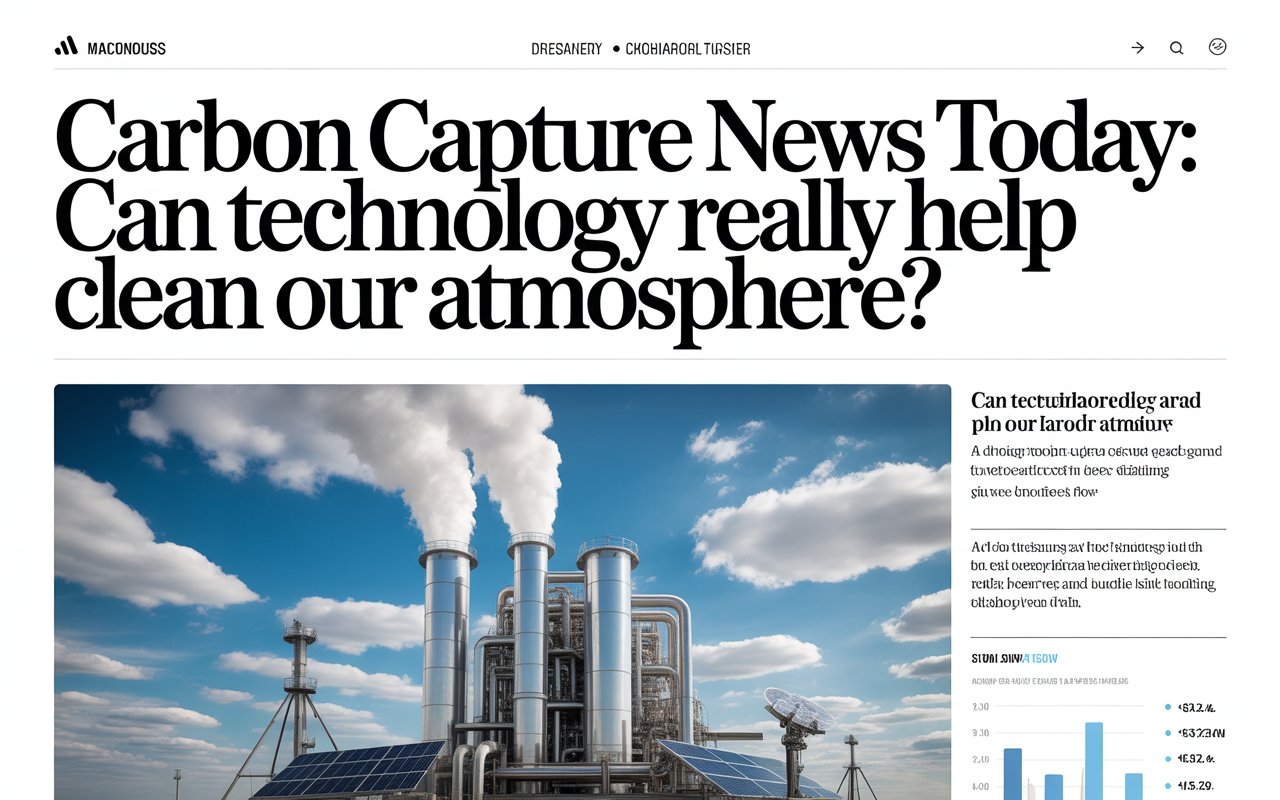
Climate change has become one of the most discussed issues in the world today. Governments, scientists, and businesses are constantly searching for solutions that can reduce greenhouse gases while allowing economies to continue growing. One idea that has recently gained a lot of attention is capturing carbon dioxide before it reaches the atmosphere.
But what exactly is happening in this space right now? Is it just another environmental trend, or could it become a major part of the planet’s climate strategy?
Recent developments suggest that interest in this technology is accelerating. From large-scale industrial projects to innovative startups experimenting with new methods, the field is evolving quickly. In this article, we’ll explore the latest developments, how the technology works, why it matters, and the challenges that still stand in the way.
Think of the atmosphere like a bathtub slowly filling with water. If the faucet keeps running, the tub will eventually overflow. Cutting emissions is like turning the faucet down—but removing carbon from the air is like pulling the plug to drain the tub. Both actions may be necessary if we want to keep the water level under control.
Let’s take a closer look at what’s happening today.
Understanding Carbon Capture: The Basic Idea
At its core, carbon capture is a method designed to trap carbon dioxide before it escapes into the air. The process usually happens at large industrial facilities such as power plants, steel factories, or cement production sites.
Instead of releasing emissions into the atmosphere, special equipment separates the gas from other exhaust gases. Once captured, it can either be stored deep underground or reused in different industries.
The concept sounds simple, but the technology behind it is complex. Engineers use chemical reactions, special filters, or advanced materials that bind with carbon dioxide molecules. These systems are carefully designed to work in environments where massive volumes of gas move through pipelines and smokestacks.
The goal is clear: reduce the amount of greenhouse gases entering the atmosphere while keeping industries running.
Why Carbon Capture Is Making Headlines Today
Over the last few years, global attention toward climate solutions has increased dramatically. Governments are setting ambitious targets to reduce emissions, and companies are under pressure to demonstrate environmental responsibility.
Several factors explain why this technology is appearing more frequently in news reports:
Growing climate commitments
Many countries have pledged to reach net-zero emissions within the next few decades. That means balancing the amount of greenhouse gases produced with the amount removed.
Industrial challenges
Some industries, like cement and steel production, are difficult to decarbonize using renewable energy alone. Capturing emissions directly from these processes offers a potential solution.
Investment surge
Billions of dollars are now flowing into climate technologies. Venture capital firms, governments, and major corporations are funding projects designed to remove or store carbon.
Because of these developments, this technology is shifting from a theoretical concept to real-world infrastructure.
How the Technology Actually Works

The process typically involves three main stages: capture, transport, and storage.
1. Capture
The first step occurs where emissions are produced. Equipment installed at factories or power plants separates carbon dioxide from other gases.
There are several techniques used for this stage:
- Post-combustion capture – removing carbon after fuel has been burned
- Pre-combustion capture – separating carbon before fuel is burned
- Oxy-fuel combustion – burning fuel in pure oxygen to create a concentrated stream of carbon dioxide
Each method has advantages depending on the type of facility involved.
2. Transportation
Once captured, the gas must be moved to a storage location. Pipelines are the most common method, though ships and trucks can also be used in some situations.
3. Storage
The final step involves injecting carbon dioxide deep underground into geological formations. These sites often include depleted oil reservoirs or deep saline aquifers.
If done correctly, the gas can remain trapped for thousands of years.
Major Projects Around the World
Several large-scale projects have recently entered the spotlight, demonstrating how quickly this field is expanding.
In North America, multiple industrial hubs are being developed where several companies share the same capture and storage infrastructure. These hubs allow factories to connect to a central pipeline network that transports emissions to underground storage locations.
Europe is also investing heavily in this technology. Governments there are building cross-border infrastructure designed to transport captured carbon from industrial regions to offshore storage sites beneath the North Sea.
Meanwhile, countries in Asia and the Middle East are exploring similar projects, particularly in regions with strong energy industries. These initiatives aim to reduce emissions while maintaining economic growth tied to heavy manufacturing and energy production.
Together, these projects suggest that the technology may soon move from pilot programs to widespread industrial use.
The Rise of Direct Air Capture
Most traditional systems capture emissions directly from industrial sources. However, a newer approach focuses on removing carbon dioxide directly from the air.
This process is often called direct air capture.
Instead of attaching equipment to factories, large machines pull air through filters that trap carbon dioxide molecules. Once captured, the gas can be stored underground or used in other products.
While this approach sounds promising, it currently requires significant energy and remains expensive. However, researchers are developing new materials that may reduce costs and improve efficiency.
If these improvements succeed, the technology could help remove historical emissions that are already present in the atmosphere.
Government Policies Driving Growth

Policy decisions are playing a major role in accelerating development.
Many governments now provide financial incentives to companies that invest in carbon removal projects. These incentives can take several forms:
- Tax credits
- Grants for research and development
- Funding for infrastructure
- Regulatory support
For example, tax incentives in the United States have encouraged companies to build new capture facilities and storage networks. Similar programs are appearing in Europe and other regions.
These policies reduce financial risk for investors and make large-scale projects more economically viable.
Corporate Investments and Industry Partnerships
Another important trend in recent developments is the growing involvement of major corporations.
Energy companies, technology firms, and manufacturing businesses are forming partnerships to develop large-scale capture projects. Some companies are even purchasing carbon removal services in advance to offset their future emissions.
For businesses, this technology offers two key advantages:
- It helps meet climate commitments.
- It creates new markets and business opportunities.
Some startups are also experimenting with creative uses for captured carbon dioxide, turning it into building materials, synthetic fuels, or carbonated products.
These innovations could transform emissions from a waste product into a valuable resource.
Environmental Benefits and Potential Impact
The biggest advantage of this technology is its potential to reduce greenhouse gases at scale.
Certain industries produce emissions that are extremely difficult to eliminate entirely. For example, chemical reactions in cement production naturally release carbon dioxide. Capturing those emissions may be the only practical way to significantly reduce the industry’s climate impact.
In addition, removing carbon directly from the atmosphere could help offset emissions from sectors that are harder to decarbonize, such as aviation.
When combined with renewable energy and energy efficiency improvements, this technology could become part of a broader climate strategy.
Challenges and Criticisms

Despite its promise, carbon capture remains controversial in some circles.
High costs
Building and operating capture facilities can be expensive. Large projects often require billions of dollars in investment.
Energy requirements
Some systems require significant energy to operate. If that energy comes from fossil fuels, it could reduce the overall climate benefits.
Long-term storage concerns
Although geological storage is considered safe when properly managed, critics worry about potential leaks or monitoring challenges over long periods.
Dependence on fossil fuels
Some environmental groups argue that investing in capture technology could delay the transition to renewable energy by allowing fossil fuel use to continue.
These debates highlight the importance of carefully balancing climate strategies.
Innovations Shaping the Future
Researchers and engineers are constantly experimenting with new ideas to improve performance and reduce costs.
Some promising innovations include:
Advanced materials
Scientists are developing specialized filters and chemical compounds that can capture carbon dioxide more efficiently.
Mineralization
This method turns captured carbon into solid minerals, permanently locking it away in rock-like materials.
Ocean-based removal
Some experimental projects explore ways to enhance the ocean’s natural ability to absorb carbon dioxide.
Artificial intelligence
Machine learning tools are being used to optimize capture processes and reduce energy consumption.
As these innovations evolve, they could dramatically expand the potential of carbon removal technologies.
What the Future Might Look Like
Looking ahead, many experts believe carbon capture will play a supporting role rather than a standalone solution.
Reducing emissions at the source—through renewable energy, efficiency improvements, and cleaner transportation—remains the most important strategy. However, capturing carbon may help deal with emissions that are otherwise difficult to eliminate.
Imagine a future where industrial plants operate with minimal emissions, cities run on renewable energy, and advanced technologies quietly remove carbon from the air in the background.
That vision may sound ambitious, but the rapid pace of innovation suggests it could become reality sooner than many people expect.
Conclusion
The latest developments show that carbon capture is moving from theory into practice. Governments, businesses, and researchers are investing heavily in technologies designed to reduce emissions and remove carbon dioxide from the atmosphere.
While challenges remain—including cost, energy use, and public skepticism—the momentum behind these efforts is growing. Large industrial projects are already underway, and new innovations continue to emerge.
Ultimately, tackling climate change will likely require a combination of solutions. Renewable energy, improved efficiency, and carbon removal technologies may all work together to reduce the amount of greenhouse gases warming our planet.
The question isn’t whether a single solution can solve the problem—but how different solutions can work together to protect the environment while supporting modern economies.
As research continues and infrastructure expands, the role of carbon capture in global climate strategy will become clearer in the years ahead.
FAQs
1. What is carbon capture and how does it work?
Carbon capture is a process that traps carbon dioxide produced by industrial activities or power generation before it enters the atmosphere. The gas is separated, transported, and then stored underground or reused in various products.
2. Why is carbon capture important for climate action?
It helps reduce greenhouse gas emissions from industries that are difficult to decarbonize. By preventing carbon dioxide from reaching the atmosphere, it can play a role in slowing global warming.
3. What is the difference between carbon capture and direct air capture?
Traditional carbon capture collects emissions directly from industrial sources, while direct air capture removes carbon dioxide that is already present in the atmosphere.
4. Is carbon capture safe for long-term storage?
When properly managed, captured carbon can be stored deep underground in geological formations designed to hold gases securely for thousands of years.
5. Can carbon capture completely solve climate change?
No single technology can solve climate change on its own. Carbon capture is considered one tool among many that can help reduce emissions when combined with renewable energy and other sustainability efforts.







Post Comment